

Managing construction projects is about much more than completing jobs on time. Contractors need to handle estimates, budgets, schedules, documents, safety requirements, change orders, and team communication—all while keeping projects profitable.
As construction businesses grow, spreadsheets and manual processes often become difficult to manage. That’s where Contractor Foreman comes in.
After researching the platform and seeing how contractors use it in their daily operations, my impression is that Contractor Foreman offers an impressive balance of functionality, affordability, and practicality for construction companies looking to streamline their workflows.
What Is Contractor Foreman?
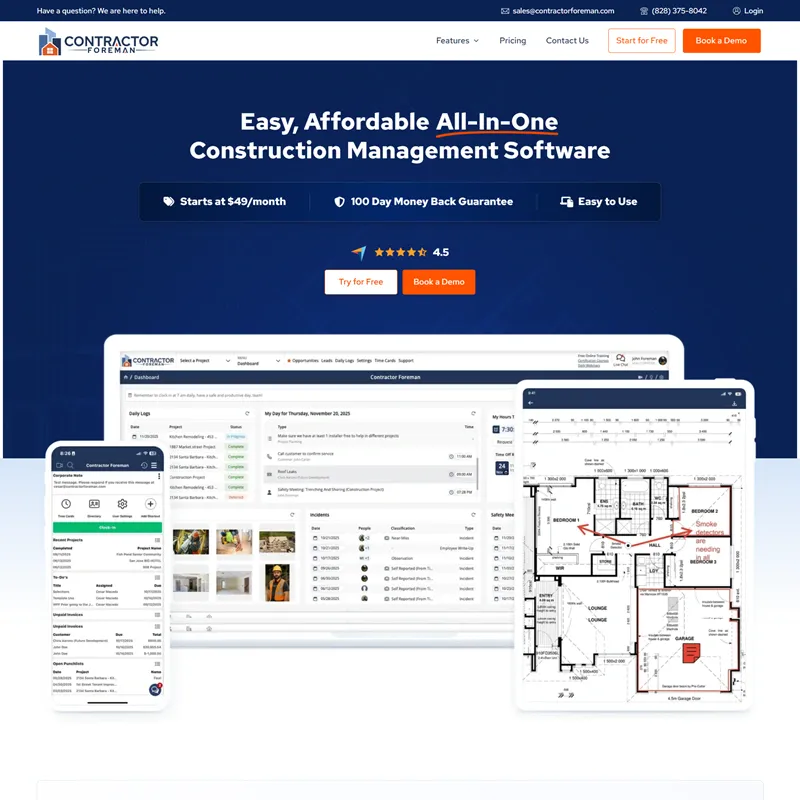
Contractor Foreman is a cloud-based construction management solution designed to help contractors organize projects, manage teams, track finances, and improve operational efficiency.
The platform combines multiple construction management functions into a single system, helping businesses reduce administrative work and gain better visibility across projects.
Instead of relying on separate tools for scheduling, estimating, and document management, contractors can manage everything from one centralized platform.
My Experience Looking at Contractor Foreman
One thing that immediately stood out to me was how comprehensive the platform feels.
Many construction software solutions focus on only one area of the business. Contractor Foreman takes a broader approach by bringing together project management, financial tracking, team coordination, and documentation tools.
What I found particularly appealing is that the platform seems designed for real-world contractors rather than corporate project managers. The tools focus on everyday construction challenges and operational efficiency rather than unnecessary complexity.
For growing construction companies, that practical approach can make a significant difference.
Why Contractors Choose Contractor Foreman
Construction businesses face unique challenges that generic project management software often struggles to address.
Common reasons contractors choose Contractor Foreman include:
- Managing multiple projects simultaneously
- Keeping project documents organized
- Tracking costs and budgets
- Improving communication between office and field teams
- Creating estimates and proposals
- Monitoring project progress
- Reducing paperwork and manual administration
As projects become larger and teams grow, having these capabilities in one place becomes increasingly valuable.
What Makes Contractor Foreman Different?
The biggest thing that stands out about Contractor Foreman is its value.
Construction software can become expensive very quickly, especially for small and mid-sized companies. Contractor Foreman has built a reputation for offering a wide range of construction-focused features without the premium pricing often associated with enterprise platforms.
It also appears to strike a good balance between functionality and usability. While the platform includes many tools, its primary focus remains helping contractors manage projects more effectively.
That focus makes it particularly attractive to businesses that need robust construction management capabilities without a massive software budget.
Benefits I Noticed
Better Project Organization
Contractors can keep project information, schedules, and documents organized in a centralized system.
Improved Visibility
Having project data available in one place makes it easier to monitor progress and identify issues early.
Reduced Administrative Work
Automation and centralized management help reduce repetitive tasks and paperwork.
Strong Scalability
The platform supports contractors as they take on additional projects and expand their teams.
Construction-Specific Functionality
Unlike generic business software, Contractor Foreman is designed around the realities of construction operations.
Pros and Cons of Contractor Foreman
Pros
- Comprehensive construction management features
- Strong value for the cost
- Centralized project management
- Supports office and field operations
- Helps improve team communication
- Suitable for growing construction businesses
- Designed specifically for contractors
Cons
- New users may need time to learn all available features
- Setup requires some initial planning
- Smaller companies may not use every available tool
- Feature-rich interface can feel overwhelming at first
Who Should Use Contractor Foreman?
Contractor Foreman is particularly well-suited for:
- General contractors
- Residential builders
- Commercial construction companies
- Remodeling businesses
- Specialty contractors
- Subcontractors
- Growing construction firms
Businesses looking to improve project organization and operational efficiency are likely to benefit the most from the platform.
Final Thoughts
After reviewing Contractor Foreman, it’s easy to understand why it has become a popular choice among construction professionals.
The platform brings together many of the tools contractors need on a daily basis while remaining accessible to small and mid-sized businesses. Its construction-specific focus, combined with its broad feature set, makes it a practical solution for companies that want to improve organization and scale their operations.
For contractors looking to replace disconnected systems and manual processes with a more structured approach, Contractor Foreman offers a compelling option.
If your construction business is growing and you need better visibility, organization, and project control, Contractor Foreman is a platform worth serious consideration.
Check it out — Get Contractor Foreman Now












































No Comments
Leave a comment Cancel